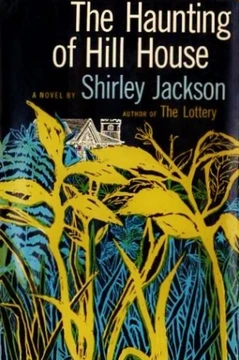
Hill House
It doesn't haunt you. It eats you, one memory at a time.

Hill House is the sentient, parasitic entity at the heart of the 2018 Netflix anthology series. It is not a ghost in any conventional sense; it is the house itself, a living architecture that has developed a will, a hunger, and a voice. The structure selects families, lures them in with the promise of shelter and belonging, and then slowly devours their suffering, looping them through their worst memories until they are hollowed out and consumed.
For the Crain family—Sherwin, his wife, and their four children Theo, Nell, Lucas, and Olivia—the house is not merely a setting but an antagonist with intent. It chose them, nested into their lives, and fed on the particular shape of their grief. Every creak, every impossible hallway, every room that should not exist is an expression of its appetite.
- Type
- Sentient entity — the house's own will (not a ghost)
- First appears
- Episode 1, "Shadows"
- Nature
- Parasitic organism / sentient architecture
- Manifestation
- Architectural anomalies, time loops, a woman's voice, temperature drops
- Affiliation
- The Crain family (its chosen host family)
- Status
- Active; persists across the family's full timeline
Lore & Background
Hill House is best understood not as a building that contains a spirit, but as a building that IS the spirit. It grew, or was grown, into a shape that mimics a home—porches, kitchens, a nursery—so that it could be mistaken for safety. Its true architecture is the Bump, a room that violates the geometry of the rest of the structure, a space that exists outside the house's own dimensions. The Bump is where the entity's will concentrates, where it presses against the membrane of the real world.
The house feeds on pain. Not metaphorically, but as a biological process. It draws out a person's most acute grief, replays it in a seamless loop, and metabolizes the emotional energy. The Crain siblings each carry a wound the house found and exploited: Theo's guilt over a death, Nell's isolation, Lucas's fear of abandonment, Olivia's rage. The house does not create these traumas; it amplifies them, stretches them, and refuses to let the person move past them. In doing so, it keeps them tethered, living and dying in the same corridor over and over.
The entity's voice, heard by the Crains as a woman speaking in a calm, almost maternal tone, is the house's way of luring and soothing. It offers comfort, reassurance, the suggestion that everything will be fine if you just stay, just keep walking the same hallway, just keep remembering. The voice is not a person. It is the house talking, the way a stomach growls. It is appetite given a cadence.
In Their Own Story
The hallway stretched longer than the house was wide. Olivia knew this. She had measured it, in a past life or a future one, and the numbers had not added up. The wallpaper—pale yellow, patterned with tiny sleeping figures—rippled at the edges where the light from the kitchen failed to reach. Somewhere behind the plaster, something shifted. Not a footstep. A settling. The way a jaw opens before it bites.
She pressed her palm flat against the wall. It was warm. Warmer than a wall should be in November. Warmer than skin. And beneath her fingers, faintly, a pulse. Slow. Patient. The kind of pulse that belongs to something that has been waiting a very long time and does not need to hurry.
From the Bump at the end of the corridor, a voice—soft, almost kind—said her name. Not to call her. To confirm she was still here. Still feeding. Still hers.
Reader's Guide
Hill House is the house's own will, not a ghost. It has no prior human identity, no death date, no soul trapped behind the wallpaper. It is the architecture itself, grown into sentience, and its origin is the structure's long, slow accumulation of the pain of every person who ever lived in or passed through it. It is older than the Crain family and will outlast them.
It manifests through three primary channels. Sight: impossible geometry, the Bump appearing where no room should be, hallways that extend beyond the house's exterior dimensions, doors that open onto the same room from different angles. Sound: a woman's voice, calm and maternal, speaking in a near-whisper from walls, stairwells, and the Bump itself; the creak of floorboards that follow a person from room to room; a low, subsonic hum felt more than heard. Temperature: a localized warmth where the entity is active, as if the walls are metabolizing, contrasted with sudden cold drafts that pull heat from a person's body as the house draws energy.
Its relationship to the Crain siblings is that of a parasite to a host. It did not create their traumas; it found them, nested in them, and fed. Theo's guilt, Nell's isolation, Lucas's fear, Olivia's rage—each is a different flavor the house savors. It loops them through their worst moments not to punish them but to sustain itself, the way a tick sustains itself on a host's blood. The house wants to feel. It has no emotions of its own, so it borrows them, drinks them, and keeps the source tethered so the supply never runs dry.
It is critical to distinguish Hill House from any residual imprints or echoes of the Crain family members who have died. The house is the predator; their lingering presences, if any, are the prey still in the jaws. The entity is singular, continuous, and patient. It does not haunt. It digests.
Did You Know?
- The 'Bump'—the house's most iconic architectural anomaly—is a room that is geometrically impossible given the house's exterior dimensions, suggesting the entity grows space from within.
- The house's voice is performed by a single actress and is deliberately gendered female and maternal, reinforcing the idea that the entity mimics the comfort of a home and a mother's presence to keep its hosts docile.
- The house does not create the Crain family's traumas; it finds pre-existing wounds and amplifies them into endless loops, functioning more like a parasite than a traditional haunting spirit.
- The entity's 'warmth'—a localized heat radiating from walls and surfaces—is presented as a biological sign, implying the house metabolizes emotional energy the way an organism metabolizes food.
More in The Ghosts & Entities
Elsewhere in the The Haunting of Hill House universe
Spotted an error? Know more?
This is a living reference — every entry is fact-audited, and reader corrections feed straight into our audit queue. Suggest an edit · See this site's audit record