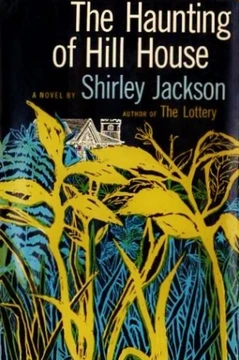
The House as Body
The house doesn't haunt you—it swallows you whole and digests your guilt.

The House as Body is the central interpretive lens through which The Haunting of Hill House (2018) renders its most unsettling idea: that the Victorian estate is not a building but a living organism, and the Crain family are not its guests but its meal. From the very first frame, the architecture is described and shot in organic terms—the front door is a mouth, the windows are eyes, the pipes are veins, the timber frame is a skeleton—and the family's descent into the house reads as ingestion, digestion, and ejection.
This motif threads every episode, deepening from the novel's original organic imagery into something more explicitly physiological. The house does not merely haunt; it metabolizes. It takes in a dysfunctional family, processes their guilt, grief, and self-deception through its shifting corridors and impossible geometry, and spits them back out altered. The result is a show where architecture becomes anatomy and every creaking beam is a heartbeat.
- Subject
- The House as Body (thematic motif)
- Source material
- Shirley Jackson's 1959 novel; adapted by Mike Flanagan
- First appears
- Episode 1
- Recurs in
- All eight episodes of the series
- Key imagery
- Mouth (front door), eyes (windows), veins (pipes), skeleton (timber frame), heartbeat (creaks and groans)
- Narrative function
- The house 'consumes' and 'digests' the Crain family's trauma
Lore & Background
In Shirley Jackson's 1959 novel, Hill House is introduced with a deliberately biological vocabulary: the front door is a mouth, the house has an appetite, and the family who enters is, in the most literal reading, eaten. Jackson's prose treats the structure as a body that breathes, grows, and contracts, and the characters' disorientation stems from the fact that its 'anatomy' does not obey Euclidean logic—hallways loop, rooms multiply, and the skeleton of the building shifts beneath their feet. The house is less a location than a digestive tract, and the family's stay is a slow, agonizing metabolism of their secrets.
Mike Flanagan's 2018 adaptation amplifies this reading into the show's structural spine. The Crain family—Theo, Olivia, Shane, Luke, and their mother Rachel—enter the house and are, in effect, swallowed. Each episode that follows traces a different 'organ' of the family's dysfunction: Theo's guilt is the liver, Olivia's rage the clenched fist of a stomach, Shane's self-destruction the rotting limb, Luke's isolation the sealed-off chamber. The house's non-Euclidean architecture is not a ghost trick; it is the internal geography of a body that is actively processing its contents. The creaking floorboards are peristalsis. The cold drafts are the house's breath.
By the present-day episodes, the metaphor becomes literal in the most visceral sense: the family is back inside the house's 'body,' and the digestion that was interrupted years ago resumes. The house does not want to kill them. It wants to finish what it started—to fully metabolize the Crain family into something that belongs to it. The final image of the series reinforces this: the house is not destroyed, not exorcised. It simply closes its mouth, satisfied, and waits for the next family to walk in.
In Their Own Story
The hallway stretched longer than the house's exterior should have allowed, and the wallpaper—peeling, damp, the color of old bruises—pressed against Theo's fingertips like the inside of a throat. He could feel it breathing. Not metaphorically. The air moved in slow, wet pulls, and the floorboards beneath his socks flexed with a rhythm that was almost, almost a pulse. Somewhere deep in the structure, a pipe groaned and shifted, the sound indistinguishable from a knuckle cracking. He pressed his palm flat against the wall. It was warm. It was, he realized with a nausea that had nothing to do with the cold, warm the way skin is warm. The door behind him had closed. Not latched. Closed. The way a jaw closes. And the house, patient and vast and full of the particular silence that follows a long swallow, was still digesting.
Reader's Guide
The House as Body is not a single image but a sustained anatomical argument the show makes across all eight episodes, and it begins the moment the front door is framed as a mouth. In Episode 1, the Crain family steps through that doorway and the camera lingers on the threshold the way a surgeon's lens lingers on an incision; the house's interior is revealed as a cavity, and the family's movement through it is choreographed like peristalsis—forward, always forward, with no option to turn back. The non-Euclidean corridors are not a supernatural trick; they are the internal geometry of a body whose organs do not sit where they should.
By Episode 3, the motif has become character-specific. Theo's guilt is mapped onto the house's 'liver'—the slow, toxic processing of something he cannot name. The scenes in which he walks the same hallway repeatedly, each pass revealing a slightly different arrangement of furniture, function as the body's immune response to a foreign substance it cannot expel. The house is not punishing him; it is trying to digest him, and the repetition is the grinding.
The present-day episodes make the metaphor inescapable. The family is literally back inside the structure, and the house's 'body' is now fully visible: the pipes are exposed veins, the beams are a ribcage, and the cold that seeps through the walls is the house's own metabolic heat. The finale does not resolve the digestion. It completes it. And the house, satisfied, goes quiet. The resonance extends beyond the plot because it names something universal: that trauma is not an event that happens to you but a process that happens inside you, and that the body—whether flesh or timber—keeps working long after the mind has decided to stop remembering.
Did You Know?
- Shirley Jackson's original 1959 novel describes Hill House's front door as a 'mouth' and gives the house an 'appetite,' establishing the bodily metaphor that the 2018 series expands into its structural core.
- The show's non-Euclidean architecture—hallways that loop, rooms that multiply, staircases that lead to impossible floors—is a visual expression of the house's internal anatomy rather than a simple ghost effect.
- Mike Flanagan has discussed in promotional interviews how the house functions as a living body that 'consumes' the family, and the production design team deliberately built sets with organic, fleshy textures to reinforce
- The series' tagline, 'We are the monsters,' reframes the House-as-Body metaphor: the family is not the patient and the house is not the disease; the family's dysfunction is the pathogen the house is trying to metabolize.
More in Themes & Symbolism
Elsewhere in the The Haunting of Hill House universe
Spotted an error? Know more?
This is a living reference — every entry is fact-audited, and reader corrections feed straight into our audit queue. Suggest an edit · See this site's audit record